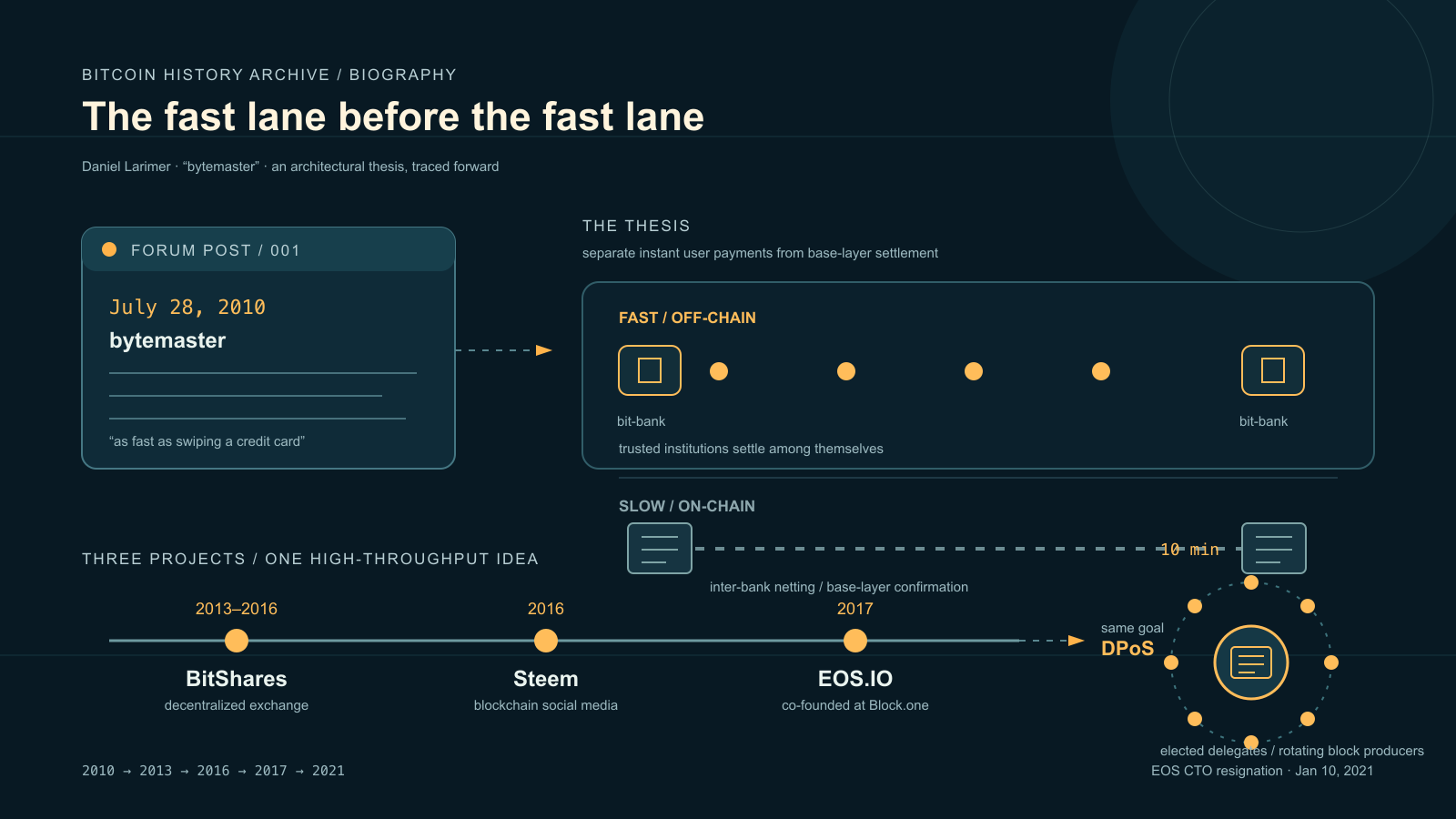
On July 28, 2010, a BitcoinTalk user named bytemaster made his first forum post:
“I am convinced that bandwidth, disk space, and computation time necessary to distribute and ‘finalize’ a transaction will be prohibitively expensive for micro-payments. […] 10 minutes is too long to verify that payment is good. It needs to be as fast as swiping a credit card is today.”
In the same post he proposed “bit-banks” — trusted institutions that would settle among themselves off-chain, with on-chain settlement reserved for inter-bank netting. The architectural thesis — decouple fast user-level transactions from slow base-layer consensus — would become the design premise of three major blockchain projects he later founded: BitShares (2013–2016), Steem (2016), and EOS.IO (2017, with Brendan Blumer at Block.one). Each implemented Delegated Proof-of-Stake to pursue the same goal by concentrating block production in a rotating set of elected validators. Bitcoin’s own answer to the same problem followed exactly the “off-chain instant, on-chain settlement” pattern he sketched — Lightning, Liquid — but kept the open validator set he was willing to give up.
Later Projects
Between 2013 and 2016, Larimer worked on BitShares, a decentralized exchange platform built on DPoS. In 2016 he moved to Steem, a blockchain-based social media platform. In 2017 he co-founded EOS.IO with Brendan Blumer at Block.one, and served as its CTO until announcing his resignation on January 10, 2021. Each project pursued the same premise: high-throughput consensus by concentrating block production in a rotating set of elected validators.
Significance
Larimer’s 2010 BitcoinTalk posts are among the earliest public arguments that Bitcoin’s base layer would not by itself serve micropayments or retail-speed commerce. History validated both sides of that argument in different ways — Bitcoin layered solutions (Lightning, Liquid) followed exactly the “off-chain instant, on-chain settlement” pattern he sketched, while his own projects pursued it by sacrificing the open validator set for higher throughput. Either way, his 2010 objection marks the point where a coherent counter-vision to pure Nakamoto consensus enters the public record.